

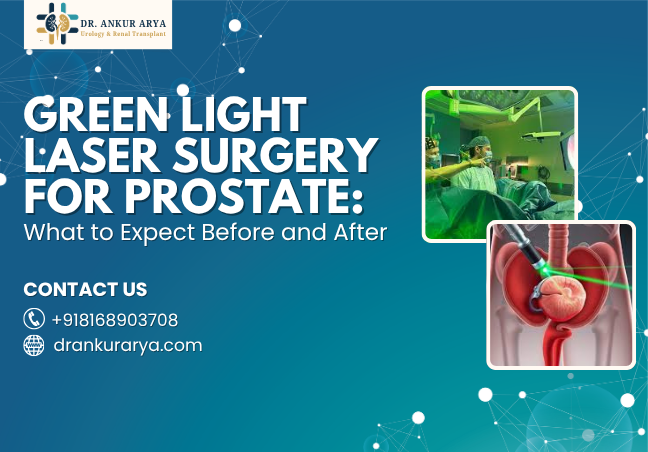
Green Light Laser Surgery for Prostate: What to Expect Before and After
If you or someone you love has been diagnosed with an enlarged prostate — medically known as Benign Prostatic Hyperplasia (BPH) — and medications are no longer providing relief, your doctor may have recommended Green Light Laser Surgery.
As the best urologist in Paschim Vihar, Dr. Ankur Arya has performed this procedure on hundreds of patients and understands that the more informed you are, the more confident and calm you'll feel walking into the operation theatre. This blog is your complete, honest guide to Green Light Laser Surgery — from preparation to full recovery.
What Is Green Light Laser Surgery for the Prostate?
Green Light Laser Surgery, medically known as Photoselective Vaporisation of the Prostate (PVP), is a minimally invasive surgical procedure used to treat urinary symptoms caused by an enlarged prostate.
In this procedure, a high-powered green laser is inserted through the urethra — no incisions or cuts on the body are required. The laser energy vaporises the excess prostate tissue that is blocking urine flow, almost instantly relieving the obstruction.
Before the Surgery — What to Expect
Preparation is key to a smooth procedure and faster recovery. Here is what happens in the days leading up to your Green Light Laser Surgery:
Medical evaluation and tests:
- Complete blood count, kidney function tests, and urine culture
- PSA (Prostate Specific Antigen) test to rule out prostate cancer
- Urodynamic studies to assess bladder function
- Ultrasound to measure prostate size
- ECG and anaesthesia fitness evaluation
Medication adjustments:
- Blood thinners like aspirin or warfarin must be stopped 5–7 days before surgery as advised by your doctor
- Inform your urologist about all supplements and medications you are taking
- Antibiotics may be prescribed before surgery to prevent infection
On the day of surgery:
- You will be asked to fast for at least 6–8 hours before the procedure
- The surgery is performed under spinal or general anaesthesia
- The entire procedure typically takes 45 minutes to 1.5 hours depending on prostate size
- Most patients are admitted as a day care or overnight case — no long hospital stay required
During the Surgery — What Actually Happens
Once anaesthesia is administered, a thin instrument called a cystoscope is inserted through the urethra. Through this, the green laser fibre is passed directly to the prostate.
The laser fires precisely controlled pulses of energy that instantly vaporise the obstructing prostate tissue. There is no cutting, no stitches, and virtually no blood loss — making it particularly safe for elderly patients and those on blood thinners.
A urinary catheter is placed at the end of the procedure to allow healing and help drain urine. This catheter is usually removed within 24 to 48 hours after surgery.
After the Surgery — Recovery and What to Expect
This is the phase most patients are most anxious about. Here is a clear, realistic picture of what recovery looks like:
First 24–48 hours:
- Mild burning or discomfort during urination is normal and expected
- You may notice pink or light red urine due to minor bleeding — this settles quickly
- The urinary catheter is removed after 1–2 days
- Most patients are discharged and back home within 24–48 hours
First 1–2 weeks:
- Urinary frequency and urgency may persist temporarily as the bladder adjusts
- Avoid strenuous physical activity, heavy lifting, and long distance travel
- Drink plenty of water — at least 2.5 to 3 litres per day to flush the urinary tract
- Avoid spicy food, caffeine, and alcohol during recovery
- Sexual activity should be avoided for at least 2–3 weeks
Week 3 onwards:
- Most men notice a dramatic improvement in urine flow and reduction in symptoms
- Return to light work and daily activities is typically possible within 1–2 weeks
- Full recovery and maximum benefit is usually achieved within 4–6 weeks
Long-term results:
- Studies show that Green Light Laser Surgery provides significant symptom relief in over 90% of patients
- Results are long-lasting — most men do not require repeat surgery for many years
- Unlike traditional TURP surgery, the risk of retrograde ejaculation is lower with this procedure
Conclusion
Green Light Laser Surgery for the prostate is a game-changing procedure for men suffering from the debilitating urinary symptoms of an enlarged prostate. It is safe, effective, minimally invasive, and delivers lasting relief — often in a single day's hospital visit.
Dr. Ankur Arya, widely trusted as the best urologist in Paschim Vihar, practises at BLK-Max Super Speciality Hospital and brings over 16 years of advanced urological and surgical expertise to every patient he treats. Whether you need a consultation, second opinion, or are ready to explore surgical options, Dr. Arya and his team are here to guide you every step of the way — with precision, compassion, and the highest standard of care.
FAQs
Q1. How long does the Green Light Laser Surgery take?
The procedure typically takes 45 minutes to 1.5 hours depending on the size of the prostate.
Q2. Will I feel pain during or after the surgery?
The procedure is done under anaesthesia so there is no pain during surgery. Mild discomfort or burning during urination after the catheter is removed is normal and settles within a few days.
Q3. When will I see improvement in urine flow?
Most patients notice significant improvement within the first few days after catheter removal. Full benefit is usually experienced within 4–6 weeks.
Q4. Can Green Light Laser Surgery affect sexual function?
The risk is much lower compared to traditional TURP surgery. However, retrograde ejaculation (dry orgasm) can occur in some patients. Erectile function is generally not affected.
Q5. Is Green Light Laser Surgery permanent?
Results are long-lasting for most patients. The majority do not require repeat surgery for many years. Your urologist will advise on long-term follow-up to monitor prostate health.